AiactoraSelf-Hosted EU AI Act Register: Classification, Literacy, Oversight
Self-hosted EU AI Act register: every AI system classified by the article that actually applies, with the Article 4 literacy record and named human oversight, bought once.
No sign-up, no password — the demo opens already signed in, on sample data.
- Full PHP source included
- Instant download + licence key
- It never phones home
- Compare vs SaaS pricing →
The problem it solves
Searching for self-hosted EU AI Act register software mostly returns consultancies and GRC suites priced for enterprises. Aiactora is the register itself: $79 one-time, plain PHP you host, every AI system classified under the article that actually applies, the Article 4 literacy record, and named human oversight — kept on your own server, where a regulator would expect to find it.
The AI Act does not arrive on one date. Article 113 sets four, and the duties that bit first — Article 4 literacy and the Article 5 prohibitions — applied from February 2025, before most organisations had a list of the AI they use at all.
The list is the hard part. The same business is usually the deployer of one tool and the provider of another, and the obligations are not the same. That distinction is exactly what a spreadsheet loses.
- A register kept in a spreadsheet that records the tool but not the role you hold for it
- Enterprise GRC priced per seat, per year, for what is fundamentally a list with dates on it
- No evidence at all for Article 4 literacy, because nobody was tracking who was trained on what
What you get
Provider, deployer, importer or distributor, quoted from Article 3. The same organisation is routinely the deployer of one tool and the provider of another, and the duties differ. Recording the role is what makes the rest of the register mean anything.
Answer, and the engine returns the class, the article it relied on, and the date those obligations bite: Article 5 prohibitions, 6(1) safety components, 6(2) with all eight Annex III areas in the Regulation words, the 6(3) derogation, Article 50 transparency, Chapter V models. The verdict updates live as you answer.
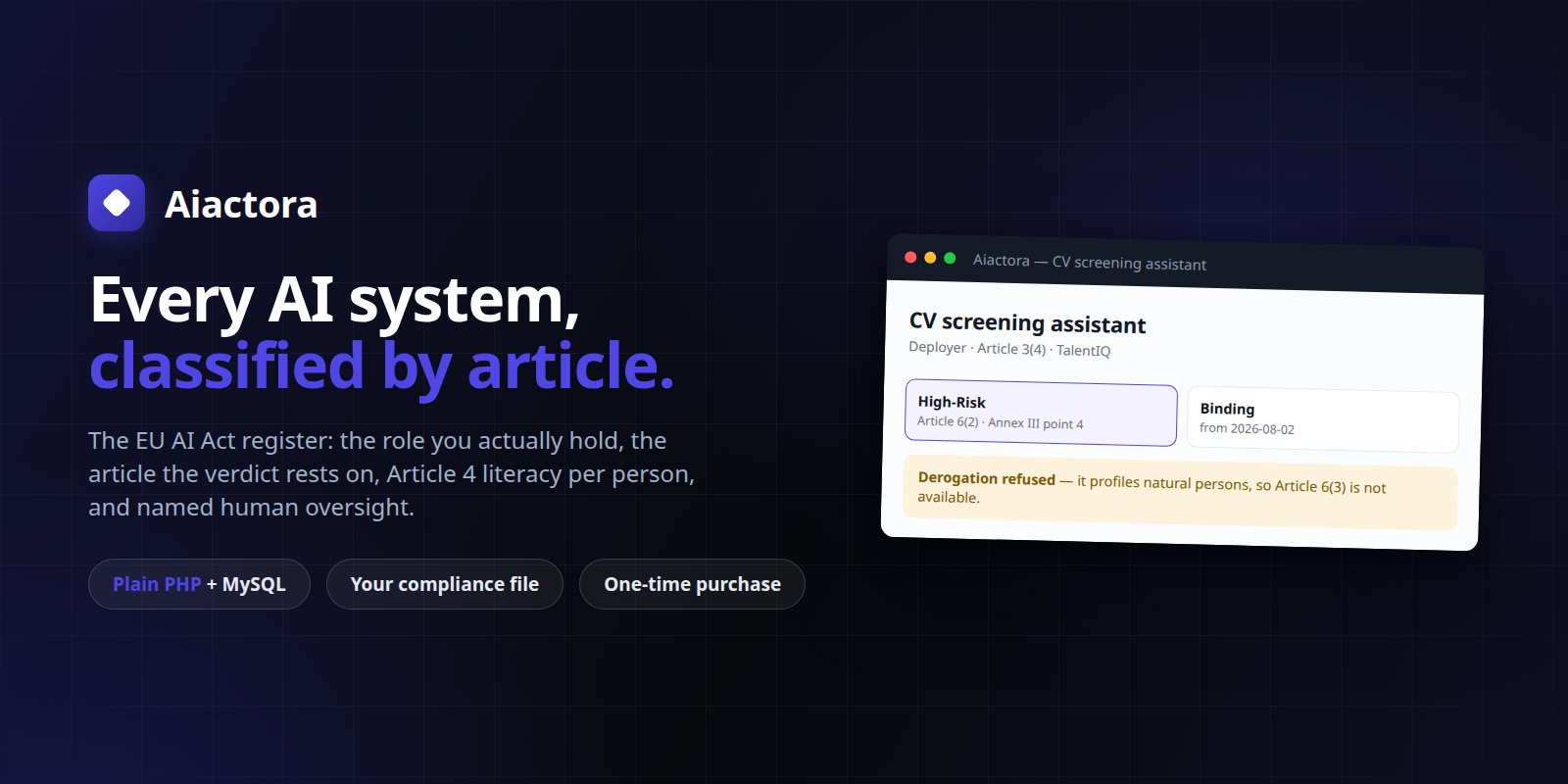
The derogation is the most attractive answer on the form. A system that performs profiling of natural persons stays high-risk and the claim is overridden explicitly; the condition relied on is recorded rather than a bare yes; and claiming it RAISES the documentation duty. Whether a system poses a significant risk of harm is returned to you as an open question.
Who owns or oversees a system, what they did, when, and where the evidence lives. The dashboard names the people with no current record, which is the only form of this that survives an inspection.
A person with the authority to stop the system, and how they stop it. The team oversees it is refused: an authority nobody can exercise is not oversight.
Which general-purpose models a system stands on, and whether you hold the provider documentation — because Chapter V binds the model provider, and what a deployer needs on file is their paperwork.
A register PDF, a per-system file, and two CSVs: systems with their classification and basis, and the literacy record. Evidence attaches to the record itself, sniffed by magic bytes and re-checked by the controller that serves it.
The 3.1 wave gave the catalogue a way to reach the other side of the transaction: counterparty email through your own SMTP server, calendar feeds your own calendar subscribes to, attachments filed where the paperwork belongs, and export presets other people's software imports. Every outbound path ships switched off, runs on your own credentials, and can never break the thing that triggered it. This app gained no new outbound path in 3.1 — its pass rewrote the honest-limitations list against the shipped code instead, which is the more useful change when the product was already complete.
See it running — right now, on sample data
No sign-up, no password — it opens already signed in, and resets itself. Click around freely.
Open the live demoIs Aiactora right for you?
Before the price, not after it: what Aiactora deliberately does not do. We publish this on every product because the wrong purchase costs you more than the price.
- The law moves, and your copy does not move itself. The register reflects Article 113 as amended by Regulation (EU) 2026/1744 (the Digital Omnibus on AI, in force 27 July 2026), verified against EUR-Lex on 23 August 2026. When the Act is amended again, re-download the current build from your order page — updates are free — and check the dates against EUR-Lex before relying on them
- It is not legal advice, and it cannot be. Where the Act leaves a judgement to you, it returns that as an open question and records what you decided
- The answers are yours. A classification is only as good as the description of what the system does; the questionnaire cannot audit your own account of your own tools
- EU AI Act only — not GDPR, not the DSA, not sectoral regulators, not any non-EU AI regime
- No conformity assessment, no CE marking, no technical documentation generator
- No model evaluation, no bias testing, no red-teaming — it records that you hold the evidence, it does not produce it
- Single-tenant: one organisation per installation
Still the right fit? See the price → · Not sure — see who should stay with the SaaS →
Pricing — one-time, yours forever
- ✔ Full source included — PHP you can read and change
- ✔ No subscription. One payment, yours forever
- ✔ It never phones home
- ✔ Your data stays on your server
- ✔ 14-day refunds — we’d rather refund than argue
- ✔ Offline test suite in the box — run it before you rely on it
- ✔ If we ever stop: after 1 year the domain limit lifts, after 3 years your copy relicenses to MIT — it’s in the licence
Not ready to own it? Ownware Cloud runs selected apps from $12/month — and after 12 paid months the perpetual self-host licence is yours.
 AlternativeTo
  SaaSHub
  Uneed
Uneed  SourceForge
 Read before you buy — what the zip looks like inside
aiactora/
  README.md · QUICKSTART.txt · LICENSE.txt
  app/
    index.php · router.php · config.sample.php · Dockerfile
    src/          the classes — plain PHP 8, no framework, no Composer
    controllers/  every route handler
    views/        every screen
    tests/        the offline test suite — run it yourself: php tests/run.php
    bin/          packaging · seeding · maintenance scripts
    API.md        the REST + webhook + MCP reference
Nothing is obfuscated or encoded. What you read is what runs.
Which licence do I need?
It comes down to how many installations you need. Running your own business on one site is the Single licence. Building or running sites for other people — a second domain of your own, or an installation a client keeps — is the Extended licence.
Single licence
One (1) domain or subdomain
One business, running it on one site.
- Install it on one domain or subdomain you own or operate
- Change the source however you like for that installation
- Run your own business on it commercially, client work included
- Re-download the current build any time from your buyer portal
- A second site, or an installation you hand to a client as theirs, needs the Extended licence
- No reselling, redistributing or sublicensing the source
- Not for offering it to other people as a hosted service
Extended licence
Unlimited sites you own or operate
Agencies, and anyone running it on more than one site.
- Everything the Single licence grants
- Install it on as many domains as you own or operate — no cap on the number
- Build and hand over one installation per client project
- Still no reselling or redistributing the source itself
- Running it as a multi-tenant service others sign up for needs a SaaS agreement
Every download carries the full terms as LICENSE.txt, and the licence you bought is
named on your order and in your buyer portal. The complete wording lives on the
terms page, and the live demo is free for as long
as it takes to decide.
No reviews yet — so here is what we offer instead. Every competitor price on our comparison pages is source-linked and dated, and when a vendor’s price won’t load we say so rather than guess. See the sources for yourself →
After you buy
The four things people ask right before they decide.
Your download link always serves the current build at the time you fetch it — re-download any time from your order page or the buyer portal. No renewal fee to keep what you bought.
Email support for installation and for defects in the code as delivered — a person answers, usually within a day or two. It does not cover custom development or server administration. What support covers →
Refunds are handled by Lemon Squeezy as Merchant of Record, case by case — if something is broken and we can’t fix it, we’d rather refund than argue. EU consumers additionally hold the statutory 14-day right until delivery starts. Refund terms →
Nothing stops. You hold the full PHP source, it runs on your own server, and the software does not phone home — there is no licence check that can fail and no cloud that can be switched off. LICENSE.txt ships inside the zip, so your right to keep running it never depended on this site existing.
Covered in these guides
Six dates, not one — and three of them have already passed. Six days before the deadline, the Digital Omnibus moved the high-risk regime to 2027. What Article 4 has required since February 2025, what Article 50 still adds on 2 August 2026, what was deferred and what was not — and the one question on
Questions about Aiactora
Does it tell me whether my system is high-risk?
It applies the Regulation to the answers you give and names the article it used. Where the Act leaves a judgement to you — most importantly whether an Annex III system poses a significant risk of harm under Article 6(3) — it returns that as an open question and records what you decided. It will not decide it for you, and no software honestly can.
Is this legal advice?
No. It is a register that maps your answers onto the Regulation and shows its working. It is the file you bring to the lawyer, not the lawyer.
Does it cover GDPR or the DSA?
No. EU AI Act only, and it says so. Not GDPR, not the DSA, not sectoral regulators, not any non-EU AI regime.
Does it generate technical documentation or a CE marking?
No. There is no conformity assessment, no CE marking and no technical documentation generator. It records what class a system is in, on what basis, and what evidence you hold.
Where does the data live?
On your server. Plain PHP 8 with MySQL or MariaDB — SQLite for a trial — no Composer and no build step. Your compliance file is not in anyone else cloud, which is the point.