Ownware OS
The whole catalog plus the control plane — every Ownware app and the SaaS Kit console, one payment, your server.
$1,299.00 one-time — 48 products included, $3,907.00 if bought separately save $2,608.00

Why this suite
Odoo's pitch is integration: one suite, everything connected — and everything entangled, hosted their way, priced per app per user. The honest opposite is not one giant app; it is small, sharp apps that stay separate, with one console to run them.
Ownware OS is the whole shelf: every app in this catalog, plus the SaaS Kit control plane that provisions each one headlessly into its own isolated database on your server. One console login to install, manage, and monitor them; each app keeps its own focused interface and its own data. Separate by design — that is the feature, not the compromise.
- Every current catalog app, one payment — new tools you'd otherwise buy one by one
- The SaaS Kit console: self-serve provisioning, per-app isolated databases, health in one dashboard
- One-click console→app sign-in: signed, single-use hand-off links open any provisioned app's admin — no second password (each app also keeps its own standalone login, by design)
- Backup orchestration built in: one command snapshots every app's database (integrity-checked, rotated), and the console shows each app's backup age — the same engine Ownware Cloud runs nightly
- No per-app, per-user, per-month meter — the anti-Odoo, owned outright
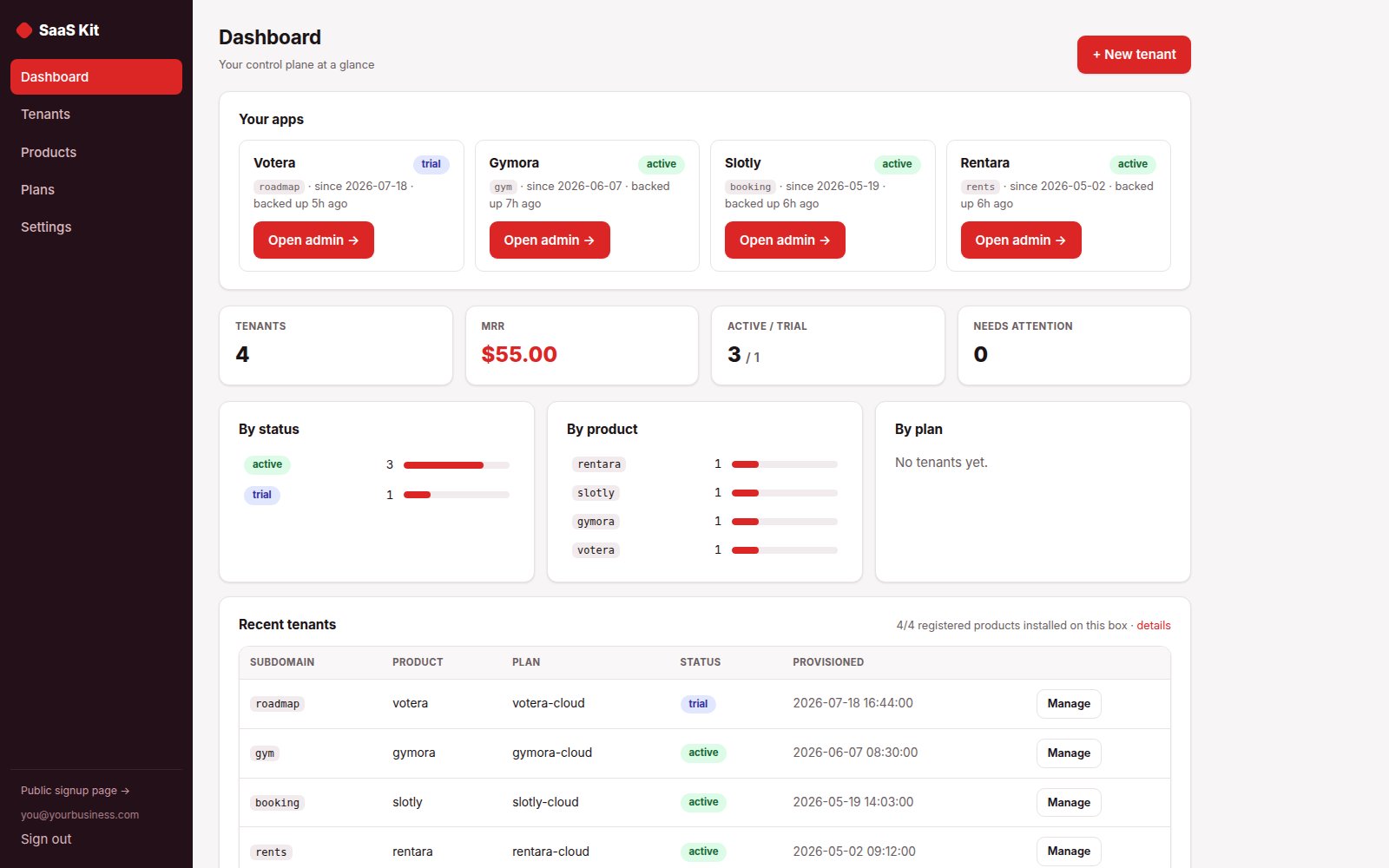
The console — see it running
One login: every app as a tile, live status, backup age, and a single-use “Open admin” hand-off into each. Rendered below with a sample four-app apps — the same console ships in the box and runs our hosted tier in production.
What's inside — 48 full products

SaaS Kit — Multi-Tenant Control Plane for PHP Apps
Turn any single-tenant PHP app into a multi-tenant SaaS with its own database per tenant.

Invora — Recurring Invoicing with Client Payment Links (PHP + MySQL, Self-Hosted)
Self-hosted recurring invoicing for freelancers and small firms: every cycle lands as a draft you approve before it goes out, and each unpaid invoice carries your own payment link.

Slotly — Appointment & Booking System (PHP + MySQL, Self-Hosted)
Self-hosted appointment booking engineered so it can't double-book.

Vendra — POS & Inventory System (PHP + MySQL, Self-Hosted)
Self-hosted POS & inventory engineered so overselling is impossible.

Gymora
Self-hosted gym membership manager with front-desk check-in guards and class-pack credit tracking.

Rentara
Automatic rent posting, late fees, and a tenant self-service portal for the portfolio you already manage.

Consigna — Self-Hosted Consignment & Resale-Shop Manager
Self-hosted consignment shop software with penny-exact payouts — an open alternative to SimpleConsign.

Approva — Amount-Based Purchase Approval Chains (PHP + MySQL, Self-Hosted)
Self-hosted purchase approvals for finance teams and cost-centre owners: requests route to one, two or three approvers by amount, and the rule that applied is frozen on the record at submission.

Cashora — Petty Cash Ledger Software (PHP + MySQL, Self-Hosted)
Self-hosted petty cash ledger software for the cash box you already keep: an imprest float, categorised disbursements, and a balance that proves out at month-end.

Commissa — Sales-Commission Calculator (PHP + MySQL, Self-Hosted)
Penny-exact commission statements — flat, tiered, or per-category — owned outright.

Privara — Self-Hosted GDPR DSAR Management Portal
Self-hosted GDPR DSAR portal that tracks every request against the one-month period Article 12(3) sets.

Confida — Whistleblowing Portal for EU Directive 2019/1937 (PHP + MySQL, Self-Hosted)
Self-hosted whistleblowing portal for organisations in the scope of EU Directive 2019/1937 (50 or more workers, Article 8(3)): the 7-day acknowledgement and 3-month feedback clocks, tracked per report.

Complia
A self-hosted complaints register with a configurable acknowledgement timer and audit export. The window is a setting — the 29-day default sits one inside the UK statutory 30.

Packora — EPR Packaging Producer Register & Report Builder
Self-hosted per-SKU packaging register for state EPR reporting — exact math, one-time price.

Safora
Replace the paper food-safety diary with auto-flagged deviations and an audit-ready PDF and CSV export.

Waiverly — Digital Waiver & E-Signature Kiosk (PHP + MySQL, Self-Hosted)
Self-hosted digital waivers with a minor/guardian gate and tamper-evident records.

Certora — Public Certificate Verification Page (PHP + MySQL, Self-Hosted)
Self-hosted certificate verification for training providers and awarding bodies: every certificate carries a unique code an employer can check on a verify page you host yourself.

Extracta — Self-Hosted AI Invoice & Receipt Data Extractor (BYO Key)
Extract invoice & receipt data with your own AI key — self-hosted, human-reviewed.

Expensa
Batch-upload receipts and let your own AI key extract, categorize, and total them into an accountant-ready report.

Specta
Batch-process up to 20 spec sheets with an AI queue, then review only the fields confidence-scoring flags.

Cargora
Extract POs and packing slips with your own AI key, then catch short shipments and price gaps automatically.

Ledgira
Upload bank or card statements and let your own AI key extract every line and auto-reconcile the balance.

Menura
Photograph a menu, extract every item and price with your own AI key, review, then export POS-ready data.

Fixora — Usage-Based Preventive Maintenance Schedule (PHP + MySQL, Self-Hosted)
Self-hosted preventive maintenance for teams running machines, vehicles or plant: every PM triggers on engine hours, distance or the calendar — whichever comes first.

Lendra
Log who has which laptop, tool, or camera checked out, and get automatic overdue flags on a live dashboard.

Restock
Import your sales history and get reorder points, days-of-stock, and suggested order quantities per SKU.

Revup — Review Requests with a Rating Gate (PHP + MySQL, Self-Hosted)
Self-hosted review requests for local service businesses: ratings at or above your threshold go to your public review page, and anything below it lands in a private inbox instead.

Permora — Permit & Inspection Tracker for Trades (PHP + MySQL, Self-Hosted)
Track permits and inspections across every job — exact date-math alerts, owned outright.

Supplia — Supplier Register & Contract-Renewal Tracker (PHP + MySQL, Self-Hosted)
Self-hosted supplier & contract register — renewal alerts, expiry warnings, committed spend by category.

Leavora — Staff Leave & PTO Tracker (PHP + MySQL, Self-Hosted)
Self-hosted staff leave & PTO — accruals, working-day requests, approvals, and live balances.

Assetora — Fixed-Asset & Depreciation Register (PHP + MySQL, Self-Hosted)
Self-hosted fixed-asset register — depreciation to the exact cent, book value as of any date.

Rostera — Staff Shift Scheduler & Rota (PHP + MySQL, Self-Hosted)
Self-hosted staff shift scheduler — a weekly rota, exact hours, double-booking caught.

Clockora — Staff Timesheet & Time Tracker (PHP + MySQL, Self-Hosted)
Self-hosted staff timesheet — hours by project, exact totals, approvals. No invoicing.

Votera — Self-Hosted Feedback Board, Roadmap & Changelog (PHP + MySQL)
Your own feedback board, public roadmap, and changelog — unlimited voters, no per-user monthly bill.

Tokora — Queue & Token Display System (PHP + MySQL, Self-Hosted)
Self-hosted queue & token display — issue numbers, call them to counters, run the waiting-room board.

Deliora — Licence-Key Delivery for Digital Downloads (PHP + MySQL, Self-Hosted)
Self-hosted licence-key delivery for people selling digital downloads: keys with per-domain activation limits, and download links that expire, served from files kept outside the web root.

Jobora — Self-Hosted Job Management: Quotes, Scheduling, Job Costing
Self-hosted field-service software: quotes that turn into jobs, a drag-and-drop schedule board, real job costing and invoices — bought once.

Warrantora — Self-Hosted Warranty & RMA Register: Expiry and Claims
Self-hosted warranty register: what you sold, when the cover ends, and every claim with the reason for each decision — computed, never stale.

Loyalora — Self-Hosted Loyalty & Rewards Register: Points, Rewards, Redemptions
Self-hosted points register with a ledger you can replay: no stored balance, no order ceiling, no monthly fee.

Fleetora — Vehicle Expiry & Service-Due Reminders (PHP + MySQL, Self-Hosted)
Self-hosted expiry and service-due reminders for small fleets: every document and every service in one ranked list, each compared against its own window in its own units — days or distance.

Cyresora — NIS2 Incident Reporting Clocks in Hours (PHP + MySQL, Self-Hosted)
Self-hosted NIS2 reporting clocks for essential and important entities: every deadline counted in hours from the moment you found out, with a record of what you sent and to whom.

Visitora — Visitor Evacuation List & Fire Roll Call (PHP + MySQL, Self-Hosted)
Self-hosted evacuation list for reception and site safety: one page naming everyone still inside, derived from the sign-in log and kept on the device for when the network dies.

Trainora — Self-Hosted Training Matrix: Competencies, Expiry, Evidence
Self-hosted training matrix: who has what, what has run out, and what runs out next — every expiry computed from the date it was achieved, never stored.

Inspectora — Self-Hosted Inspection & Calibration Register: Due Board, Logbooks
Self-hosted inspection register: what is due, what is overdue, and what was last done to it — every due date computed from the last inspection, never stored.

Onboardora — Self-Hosted Employee Onboarding: Checklists, Owners, Derived Dates
Self-hosted employee onboarding: write a checklist once and every new starter gets their own plan, with every date worked out from the day they actually start.

Membora — Self-Hosted Membership Register: Standing, Quorum, Motions
Self-hosted membership register for clubs and associations: who is in good standing, whether a meeting was quorate, and whether a motion actually carried.

Helpora — First-Response Clock for Internal Requests (PHP + MySQL, Self-Hosted)
Self-hosted first-response tracking for internal teams: the clock starts when a request arrives and stops only when a human actually answers — and nothing can be closed that was never answered.
Before you buy — what you are actually getting
What you need to run it
Plain PHP 8 with MySQL/MariaDB or SQLite, on ordinary shared hosting or the smallest VPS. Each app has its own 2-minute web installer and its own database; nothing here depends on anything else in the suite.
Try before you pay
Every product above has a live demo, linked on its card — no sign-up, seeded with sample data, reset regularly. The demos run the same builds you download.
Your data, your source
- Full PHP source included — readable, changeable
- Your data stays on your server; CSV export from every app
- It never phones home
- One-click backups in every app
Honest limitations — the whole suite
Each product's own limits apply unchanged when it arrives as part of the suite.
SaaS Kit — Multi-Tenant Control Plane for PHP Apps
- Not for $3 shared hosting — per-tenant databases need CREATE DATABASE privileges, so a VPS or a host where you control MySQL is required
- You need wildcard DNS (*.yourapp.com) pointed at your server — no wildcard record, no tenant subdomains
- Billing is bring-your-own-Stripe; this is not a payment processor and takes no cut
- Isolation is at the PHP/database level, not container level — not Docker/VM-per-tenant infrastructure isolation
- Not the end business — if you're one company wanting one instance, buy the underlying product itself, not this kit
Invora — Recurring Invoicing with Client Payment Links (PHP + MySQL, Self-Hosted)
- Invora never processes cards. Bring your own payment link (Stripe Payment Link, PayPal.me, your bank's page); payments are recorded here when they land.
- Not double-entry accounting, a general ledger or an ERP — it exports clean CSV/JSON for whatever keeps your books.
- Single-tenant: one business per installation.
- Email goes through your own SMTP server; there is no relay and no sending service.
- Nothing is emailed automatically — every client email is a button a person presses.
Slotly — Appointment & Booking System (PHP + MySQL, Self-Hosted)
- No online card processing at booking. Deposits are quoted and tracked; your own payment link (a Stripe or PayPal page) is shown to the customer beside the amount due, and Slotly never touches the card.
- Calendar feeds are one-way (Slotly → your calendar) via token-guarded .ics; external calendars are not read back.
- On the autumn DST change the repeated wall-clock hour is offered once, not twice — only relevant if you take bookings between 2 and 3 a.m.
- Not built for a multi-vendor marketplace.
- Single business per install.
Vendra — POS & Inventory System (PHP + MySQL, Self-Hosted)
- One shop per installation (single stock ledger, single drawer).
- Vendra records card tender; it does not process cards.
- No e-commerce or website stock sync.
- Emailed receipts and the day-close email need your own SMTP details, and both ship switched off; without SMTP the receipt is still printable and viewable on screen.
- Barcode hardware: keyboard-wedge USB scanners work as typed input; no driver-level integration.
Gymora
- Not a public booking site: no online timetable, reservations or membership purchase. The one member-facing screen is the self-check-in kiosk.
- Single location, single-tenant: one installation per gym.
- No built-in card processing — payments are recorded, not taken. Nothing the product sends asks a member to pay, because it cannot receive the money.
- Email goes through your own SMTP server, and every message — to you or to a member — is off until you switch it on. There is no SMS.
- Expiry notices need a scheduler:
cron/expiring.phpmust run daily — the app runs no background jobs by itself.
Rentara
- Single-operator, single-tenant install: one portfolio per installation.
- Not for finding or marketing to new tenants; not a general ledger.
- No online rent payment processing. Payments are recorded, not taken — and nothing Rentara sends a tenant asks them to pay.
- The tenant portal is a per-lease magic link: no accounts, no passwords, no payment page.
- Email goes through your own SMTP server. Messages to a tenant are off until you switch them on.
- No background jobs: arrears are computed when you look, and tenant notices fire on an event, not a schedule.
- Very large portfolios (hundreds of units) want a custom setup.
Consigna — Self-Hosted Consignment & Resale-Shop Manager
- No barcode scanner, label printer or cash-drawer hardware integration.
- No payment processing — payouts are recorded, not transmitted.
- One shop per installation; your team shares it with roles.
- The consignor portal is read-only by construction — it resolves a hashed token and renders; there is no write route behind it.
Approva — Amount-Based Purchase Approval Chains (PHP + MySQL, Self-Hosted)
- Not an accounting system or ERP; it does not post to a general ledger.
- It does not process payments — Approva approves requests and issues POs; it never moves money or pays vendors.
- No 3-way matching (PO ↔ goods receipt ↔ invoice), no inventory, no budgeting or encumbrance accounting.
- No punchout catalogues or supplier portals — a request describes the purchase in your own words.
- One currency per installation (pick any at install — EUR, GBP, AUD, CAD, CHF and more are formatted natively).
- Single-tenant: one organisation per installation.
Cashora — Petty Cash Ledger Software (PHP + MySQL, Self-Hosted)
- Cashora records cash movements; it never processes, moves or holds money.
- One business per installation (many cash boxes inside it).
- Receipts are attached files and text references — there is no OCR reading them for you.
- Counts record what was found; Cashora never invents an entry to make a difference disappear.
Commissa — Sales-Commission Calculator (PHP + MySQL, Self-Hosted)
- Commissa computes commission; it pays nobody and moves no money.
- No live CRM connection — CRM deal exports import as files, matched to reps by name.
- One currency and one company per installation.
- Reps have no logins: statements are emailed to them, never self-served.
- Nothing is emailed on a schedule — a statement email is a button a person presses.
Privara — Self-Hosted GDPR DSAR Management Portal
- No automated data-discovery across systems — it tracks requests, it does not scan your databases for personal data
- Not a full GRC suite: no policies, DPIAs, breach management, or staff training records
- Not built for multi-tenant SaaS platforms needing isolated per-customer workspaces
- Using Privara doesn't itself make you GDPR-compliant — legal sufficiency of your responses is your responsibility
Confida — Whistleblowing Portal for EU Directive 2019/1937 (PHP + MySQL, Self-Hosted)
- Single organisation per install (not multi-tenant).
- No supervisory-authority e-filing and no e-discovery platform.
- Handler email notifications deliberately carry no report content, and attachments never leave the server by email, webhook or calendar feed.
- Attachments are photos only (JPEG/PNG, metadata stripped, encrypted at rest); documents are refused because their author metadata cannot be reliably removed.
- Anonymity is an application guarantee, not a network or hosting guarantee — HTTPS and sane server logging are on you.
- Written intake only. Article 9(2) of the Directive lets a channel be "in writing or orally, or both", so a written channel satisfies it — but there is no telephone or voice-message intake here, no dedicated screen for typing up a call, and no field recording that a report arrived orally. The physical meeting a reporter may request is a process you run, not software you install.
- Aligns with the EU Whistleblowing Directive's timers and workflow; it is not legal advice.
Complia
- Single-tenant: one organisation per installation (your team shares it, with viewer / member / admin roles and invite links).
- Email goes through your own SMTP server, never ours — and there is no automatic "deadline approaching" reminder: a date passing is not an event Complia observes, and watching for it would need a background job this product does not run.
- Not a case-management suite: no assignments, no SLA escalation ladder, no billing. Attachments and an append-only investigation log are in; work allocation is not.
- English-language UI.
- A records aid, not legal advice; buying it does not make you compliant.
Packora — EPR Packaging Producer Register & Report Builder
- US-state scope; no EU/Canada programme logic and no PRO API integration.
- Fee figures are estimates from the rates you entered — no eco-modulation, minimums or mid-year schedule changes.
- You maintain the reference data (materials, deadlines, rates); verify with your PRO each cycle.
- One company per installation; your team shares it with roles.
- Annual granularity, matching the annual-report cadence.
- Reminders reach people, not portals: Packora never files, submits or logs in for you.
Safora
- Single-tenant: one business per installation (staff share the one instance, with roles).
- Safora documents your records; it does not connect to fridge probes or IoT sensors — staff enter readings, and a sensor posting to the REST API raises the same alerts a person would.
- It does not submit anything to any authority; it produces records you keep and present.
- Not legal advice, and not a certificate of compliance. The thresholds are HACCP-aligned defaults you can change; the bank-holiday list is England & Wales — one-off royal holidays, Scotland and Northern Ireland differ.
- Email goes through your own SMTP server; the open-breach chase is off until you switch it on.
Waiverly — Digital Waiver & E-Signature Kiosk (PHP + MySQL, Self-Hosted)
- No government-ID identity verification, notarization, or eIDAS advanced/qualified signatures — Waiverly proves what text was signed and that it has not changed, not who the signer legally is.
- No online payment collection: signatures, not money.
- Email goes through your own SMTP server — Waiverly ships no mail service and opens no account for you.
- A record-keeping tool, not legal advice — whether your wording protects you is a question for your lawyer.
Secreta
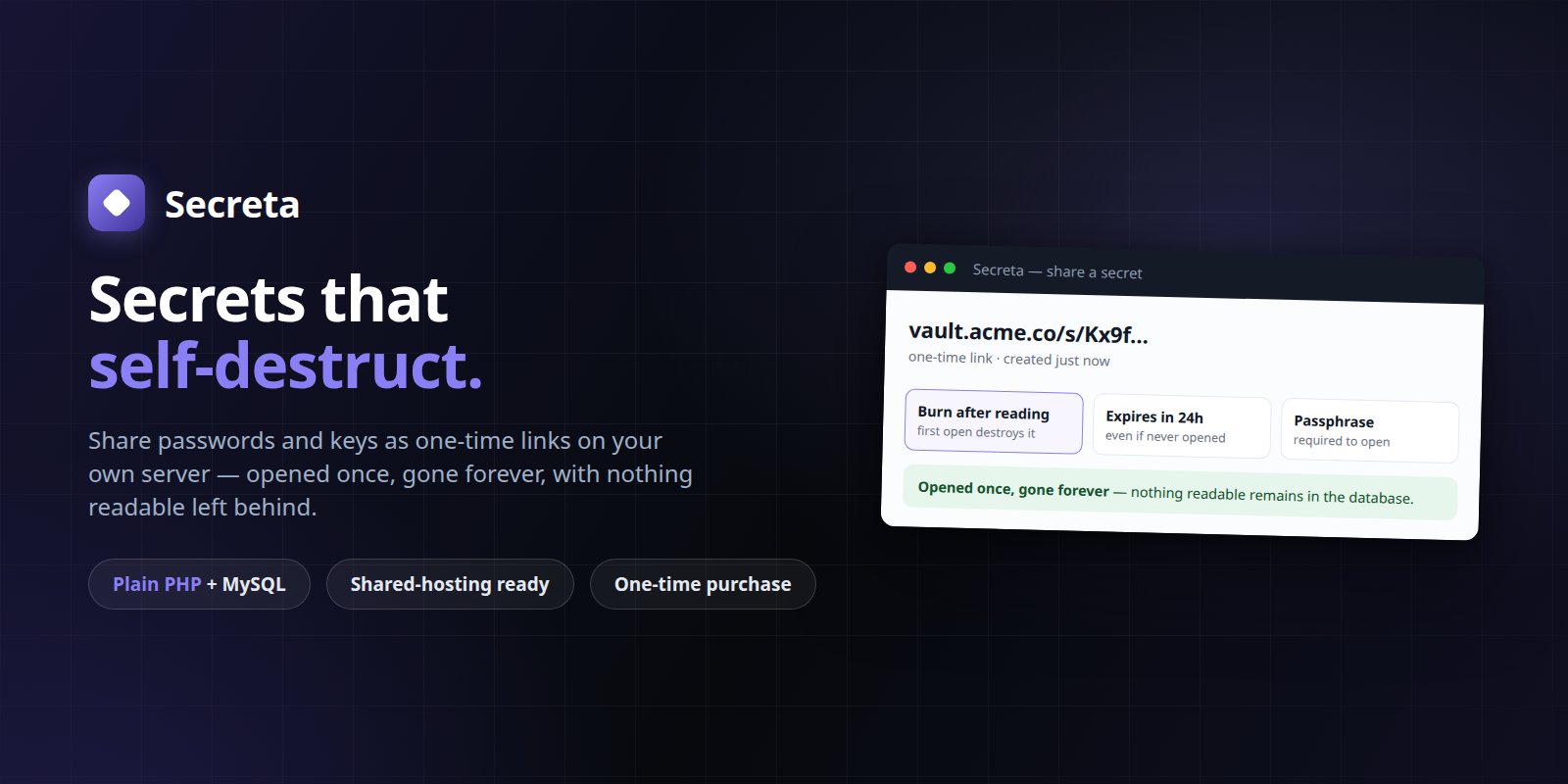
- Text secrets only — no file sharing: a file carries metadata about whoever made it, and a product whose whole claim is that the server learns nothing should not store documents it cannot read but can still leak.
- HTTPS is required in production — the encryption happens in the browser, and browsers only expose Web Crypto on a secure origin.
- Opening a link spends a view even if a passphrase attempt is wrong: the server cannot tell whether decryption succeeded — recipients are warned before revealing.
- A lost passphrase cannot be recovered. There is no reset, because the key never reached this server.
- Secreta sends no email at all: invitations and share links are handed over, never posted.
Certora — Public Certificate Verification Page (PHP + MySQL, Self-Hosted)
- Not a PKI/digital-signature system — verification is a database lookup on your server: the code resolves to the record you issued, or it does not. Provenance, not cryptography.
- Email goes through your own SMTP; certificates are delivered as a private link, never as an attachment, and delivery is off until you switch it on.
- A seal or logo on the certificate must be a JPEG or a plain 8-bit PNG (no transparency, interlacing or palette) — the PDF is written without an imaging library on purpose.
- Single-tenant: one issuing organisation per installation.
Extracta — Self-Hosted AI Invoice & Receipt Data Extractor (BYO Key)
- No API connection to accounting software — named CSV presets (QuickBooks, Xero) you upload yourself: nothing to authorise, no vendor that can cut you off.
- Single-tenant: one admin account per installation.
- No OCR built in — the vision model you configure does the reading; every extracted figure is shown for a human to approve before it counts.
- Scanned PDFs (images embedded in a PDF) may extract less accurately than native text-layer PDFs.
- Extraction accuracy is not guaranteed for any specific format, language, or jurisdiction — which is why the review screen exists.
Expensa
- No API connection to accounting software — named CSV presets (QuickBooks, Xero) you upload yourself.
- Not accounting software: it turns receipts into a reviewed, exportable expense report — no ledger, no filing.
- No OCR of our own: bring your own vision model; every figure is human-approved before it counts.
- Single-tenant: one business per installation — run one per client if you are a bookkeeper.
- Email (yours and the claimant's) goes through your own SMTP; claimant email ships off until you enable it.
Specta
- No direct storefront API integration — export CSV/JSON and import it yourself. The import-header check tells you whether that file will land cleanly in your store before you try.
- Confidence scores are heuristic, computed offline from parse quality — a review-priority signal, not a probability of correctness.
- Batches process one file per request (deliberate, for shared hosting): a 20-file batch is 20 model calls at your own provider cost, and the auto-advance page must stay open.
- BYO key: an OpenAI or Anthropic key, or a local Ollama with a vision model. Multi-page PDFs are best with Anthropic; other providers are best-effort.
- One row = one product (flat catalog): size × colour variants export as separate rows your store then groups.
- Single-tenant: one admin account per installation. No OCR built in; the model you choose does the reading.
Cargora
- No ERP or accounting API integration — Cargora writes importable files (documented columns) and you import them. No vendor API is spoken, no credentials held.
- PDF extraction works best with text-layer PDFs; scanned pages depend on the model you configure.
- One-user install (single-tenant): one admin account per installation.
- Reconciliation matches by SKU (case- and spacing-insensitive, punctuation significant); lines without a SKU are reported rather than matched.
- No OCR built in; the model you choose does the reading.
Ledgira
- No bank feed / Open Banking: Ledgira reads statement files you already have.
- No API connection to accounting software — named CSV presets (QuickBooks, Xero) you upload yourself.
- Not the book of record; it reconciles and hands off.
- No OCR of our own: bring your own model; every figure is human-approved.
- Single-tenant: one business per installation.
Menura
- No POS API integration — Menura writes files (POS CSV / nested CSV / JSON, columns documented in the README and pinned by tests) and you import them. No till vendor's API is spoken, no credentials held.
- PDF extraction works best with text-layer PDFs; a scanned or photographed menu is the model's job, and models vary.
- One-user install (single-tenant): one restaurant, one admin per installation.
- No OCR built in; the vision model you configure does the reading.
- Extraction accuracy is not guaranteed for any given menu layout or language — which is why the review screen and the POS import preview exist.
Fixora — Usage-Based Preventive Maintenance Schedule (PHP + MySQL, Self-Hosted)
- One site per installation; your team shares it with roles.
- No native mobile app — responsive web, installable as a PWA. No app-store build to keep alive.
- Meter readings are entered manually — no IoT or telematics ingest.
- No purchasing or purchase-order module — stock is adjusted by hand or consumed by a work order.
- QR tags need a phone camera and network access to your install.
- The PM calendar feed is read-only: changes are made in Fixora, not in your calendar client.
Lendra
- Single-tenant: one organization per installation.
- Not a full IT asset-lifecycle suite — no depreciation, purchase orders, helpdesk/ticketing, and no barcode label printing. The desk reads tags from any keyboard-wedge scanner; it does not make the labels.
- Not an accounting or rental-billing tool — no pricing, invoices or payments.
- Email goes through your own SMTP server. Messages to a borrower are off until you switch them on, and the same person is never written to twice in a day.
- Lendra runs no background job of its own: overdue reminders go out when you press the button, or when something runs
cron/overdue.phpon a schedule.
Restock
- Forecasts are transparent moving-average estimates from your own sales history — the math is shown, not a black box, and never a guarantee.
- One company per installation; your team shares it with roles.
- No supplier or POS API integrations — the hand-off is a file (supplier / QuickBooks / generic CSV presets, or a PDF).
- Restock plans the buying; it does not pay for it (no invoices, payments or ledger).
Revup — Review Requests with a Rating Gate (PHP + MySQL, Self-Hosted)
- Single-tenant: one business per installation (staff get their own accounts, roles and 2FA).
- Email is plain-text by design — a plain message from your own SMTP lands where a templated HTML one often does not.
- Scheduling is a send window plus one follow-up, not a branching drip campaign — a second ask reads as pestering, which costs more reviews than it wins.
- The unattended schedule needs a cron entry you install yourself (one line, printed in the app, which also shows when the runner last ran).
- Twilio is the only built-in SMS provider; manual mode works with any channel you already use.
- No direct Google/Yelp API integration — the gate links to your public review URL, and review-platform policy compliance stays your responsibility.
Permora — Permit & Inspection Tracker for Trades (PHP + MySQL, Self-Hosted)
- One company per installation; your team shares it with roles.
- Permora records what staff enter — no AHJ portal, e-permitting, filing or payment integration. That is exactly why there is no filing, payment or e-signature surface on your server to secure.
- Fee totals are single-currency by design; cross-currency sums are never shown.
- Attachments are PNG, JPEG or PDF up to 10 MB, checked by content, served only to a signed-in user through a controller.
- Calendar feeds are read-only and per-feed revocable; changes are made in Permora.
- Not legal advice: whether a permit is still valid is a question for the authority that issued it.
Supplia — Supplier Register & Contract-Renewal Tracker (PHP + MySQL, Self-Hosted)
- Single-tenant: one company per installation.
- Not a contract-lifecycle suite: no redlining, versioning, approval routing, clause library or e-signature. It files the signed thing and watches the dates around it.
- No accounting or payment integration; values and payment terms are recorded text and numbers.
- Cross-currency contract values are never summed — the value currency is one business-wide display setting.
- Uploaded documents live on your own server: type decided by the file's bytes, generated filename, 10 MB cap, served only through a permission-checked route.
- The calendar feed's URL is its credential: stored hashed, revocable, carrying no contact details and no contract values.
Leavora — Staff Leave & PTO Tracker (PHP + MySQL, Self-Hosted)
- Single-tenant: one business per installation.
- Records leave only — no payroll, no wage calculation, no HRIS integration.
- Approving is always an administrator's act; self-service employees request but never decide — including their own request.
- Carryover is a single cap per leave type; tenure tiers, negative balances and part-time proration by hours are out of scope by design.
- Monthly accrual credits a month only when the employee was employed at its start (no partial-month pro-rating), so balances imported from a pro-rating system can read slightly higher.
- Email sends through your own SMTP server; every employee email is off until you turn it on.
Assetora — Fixed-Asset & Depreciation Register (PHP + MySQL, Self-Hosted)
- Assetora is a register, not accounting advice: it does the arithmetic, you confirm the policy.
- Not a general ledger — it exports the journal a ledger imports.
- No API connection to accounting software: a file you upload, by design.
- Moves no money; connects to no bank or gateway.
- Single-tenant: one business per installation.
Rostera — Staff Shift Scheduler & Rota (PHP + MySQL, Self-Hosted)
- Not a time clock: it plans and publishes shifts; it does not capture attendance.
- No pay rates, ever — hours and coverage, not wages.
- Swap requests exist; approving a swap is always a human act — there is no automated swap engine.
- Email goes through your own SMTP server; telling staff about a published rota is off until you switch it on.
- Single-tenant: one business per installation.
Clockora — Staff Timesheet & Time Tracker (PHP + MySQL, Self-Hosted)
- Single-tenant: one business per installation.
- Hours only — no invoicing, pricing, rates, wages or payroll. No email can contain a pay figure because the product stores none.
- Overlap detection applies to clock entries (start + end); manual-duration entries have no position on the clock, so a per-employee-per-day 24-hour ceiling refuses the impossible day instead.
- Email sends through your own SMTP server; every staff-facing message is off until you turn it on.
- Reminders need a scheduler:
cron/reminders.phpmust run daily — the app does not run background jobs by itself.
Votera — Self-Hosted Feedback Board, Roadmap & Changelog (PHP + MySQL)
- Voter identity is an anonymous per-browser cookie key by default (one vote per browser); the email gate and verified voting are the opt-in escalations.
- Voters can opt in per idea to one ship notification; there is still no marketing list and no bulk mail.
- Single sign-on hand-off to your own app is on the roadmap.
- Team members are managed in the app: roles and single-use invite links.
- HTTPS recommended in production (standard for any login-bearing app).
Tokora — Queue & Token Display System (PHP + MySQL, Self-Hosted)
- The display board is a web page you open on a screen you already own — no signage hardware, ticket printer or audio caller is included, and none is driven.
- Announcements are visual: there is no audio chime or voice caller.
- Optional text alerts need your own Twilio account — Tokora ships no messaging account, and there is no email, push or WhatsApp.
- A live walk-in queue, not an appointment book: nothing here reserves a future slot.
- Single-tenant: one organisation per installation (staff get their own accounts, roles and 2FA).
Deliora — Licence-Key Delivery for Digital Downloads (PHP + MySQL, Self-Hosted)
- Payments run through a merchant-of-record or Stripe redirect — there is no on-box card processing, by design.
- Discount codes are created at your payment provider and auto-applied at checkout; prepaid redeem codes ship built-in. Deliora itself never reprices — the price a buyer sees is always the price charged.
- License signing and payment-webhook signature verification ship as demo-mode modules; real providers activate once the production signature module and keys are configured.
- No marketplace or multi-vendor features, no affiliate tracking.
- No recurring-subscription billing engine — one-time purchases with license tiers.
- Single admin login (buyers use passwordless magic links).
Jobora — Self-Hosted Job Management: Quotes, Scheduling, Job Costing
- One business per installation. Your team shares it with viewer / member / admin roles. Two trading companies means two installations.
- No payment processing, ever. An invoice can carry your payment link. Marking it paid records a fact; it does not reconcile with anything.
- No stock control. A material line is a cost against a job, not a draw from an inventory.
- Recurring work is not automated. There is no "every third Tuesday" rule that generates jobs.
- The customer sees one document at a time. No login, no history, no list of their jobs.
- Email is off until you switch it on, and it goes through your own SMTP server. No relay.
- A signature is captured, not verified. Not identity verification, not eIDAS-qualified. On a server without GD the blank-pad check falls back to a size floor, so a very small signature could be refused.
- The margin is only as honest as what you log.
- No offline mode.
- English only.
Warrantora — Self-Hosted Warranty & RMA Register: Expiry and Claims
- One business per installation.
- No customer-facing anything. No portal, no emails, no self-service claim form.
- Editing a warranty term re-dates every item registered under it.
- An item with no sale date has no expiry and is reported as
unknown. The product will not guess. - A claim's in-warranty flag is frozen when it is raised. Correcting the sale date later does not move it — which means a data-entry error found late needs the claim raising again.
- No approval workflow beyond one decision. No multi-signature chain, no escalation, no SLA timer.
- No money. Not the purchase price, not the repair cost, not a refund amount.
- Evidence is stored unencrypted on your disk, behind the login. The backup export covers the database, not the uploaded files.
- English only.
Loyalora — Self-Hosted Loyalty & Rewards Register: Points, Rewards, Redemptions
- No marketing of any kind, by design and by test — no campaigns, no mailing lists, no segments, no send-to-all
- No point-of-sale, no till integration, no e-commerce or storefront widget — points are recorded, not awarded automatically from a sale
- Holds no card numbers and processes no payments
- No tiers or VIP levels in 1.0 — one programme, one earning rate, a reward catalogue
- One business per installation
Fleetora — Vehicle Expiry & Service-Due Reminders (PHP + MySQL, Self-Hosted)
- No telematics, no GPS, no device or dongle integration of any kind — it cannot know a reading nobody entered
- No work orders and no parts inventory — it is a register, not a workshop system
- No inspection-form builder and no scheduled checklist workflow — it records faults a driver reports, not the walk-around they completed
- Installable to a phone, but page views are network-only: it does not work out of signal
- Connects to no licensing authority, insurer or manufacturer — nothing is fetched or verified for you
- Not legal or compliance advice; the document types and intervals are yours to set
- One business per installation
Cyresora — NIS2 Incident Reporting Clocks in Hours (PHP + MySQL, Self-Hosted)
- Not legal advice, and not a scope determination — it records your determination and your reasoning, it does not make it
- NIS2 is a Directive — it models the Directive's own stages, not 27 national transpositions
- It does not file anything. No integration with the CRA single reporting platform or any national portal
- Not a vulnerability scanner and not a CVE feed — a register of what you are handling, not a discovery tool
- No SOC, no SIEM, no detection — the clock starts when you record that you became aware
- Single-tenant: one organisation per installation
Visitora — Visitor Evacuation List & Fire Roll Call (PHP + MySQL, Self-Hosted)
- A sign-in book, not a security system. It records what people tell it — no ID scan, no passport read
- No door access, no turnstiles, no badge encoding — it does not unlock anything
- No photo capture, no ID upload — deliberate: neither is needed to answer "who is inside", and both are data you then have to protect
- Single-tenant: one site per installation
- Email only — no SMS, no push — through your own SMTP server, off until you switch it on twice
- The visitor is never emailed a copy of their visit — only the host arrival notice and the pre-registration link
- Not legal advice — the right retention period, and whether your site rules are adequate, are your decisions
Trainora — Self-Hosted Training Matrix: Competencies, Expiry, Evidence
- It does not issue certificates — no certificate generator; it holds the evidence you were given
- Not a learning platform — no courses, no content, no quizzes, no e-learning, no SCORM
- One tag, not a rules engine — a competency applies to everyone, or to one group
- No self-service login — the people in the register are tracked, not users
- Changing a competency's validity does not rewrite records already on file
- Single-tenant: one organisation per installation
Inspectora — Self-Hosted Inspection & Calibration Register: Due Board, Logbooks
- Not a CMMS — no work orders, no parts inventory, no maintenance planning
- It does not perform or certify inspections — it records that one happened and holds the certificate
- One tag, not a rules engine — an inspection type applies to all assets, or to one group
- No self-service login — the people named on records are tracked, not users
- Changing an interval does not rewrite records already on file
- Single-tenant: one organisation per installation
Onboardora — Self-Hosted Employee Onboarding: Checklists, Owners, Derived Dates
- Not an HR system of record — no payroll, no salaries, no contracts of employment, no holiday tracking
- No right-to-work or background-check verification — you can tick that the check happened, it does not perform it
- No payroll/HRIS connector — REST API, signed webhooks and MCP are there; wiring them is yours
- No offboarding — equipment tracks issue and return, but there is no leaver flow
- No employee self-service login — tasks owned by the starter are chased by email
- Single-tenant: one company per installation
- Not legal advice — what belongs on a checklist where you operate, and how long you keep the record, are your decisions
Membora — Self-Hosted Membership Register: Standing, Quorum, Motions
- No payment processing — it records what was paid; it does not take money
- No self-service member portal — members are tracked, not users
- No online or remote voting — it records votes taken at a meeting, it does not run ballots
- No accounting — subscriptions are a membership fact, not a ledger
- Single-tenant: one organisation per installation
- Not legal advice — what your constitution requires for quorum and eligibility is yours to set
Helpora — First-Response Clock for Internal Requests (PHP + MySQL, Self-Hosted)
- Internal requests, not a customer helpdesk — no public portal, no customer accounts
- No inbound mail — no IMAP polling, no mail parsing; requests come from the form, the API or MCP
- No self-service requester portal — requesters are recorded, not users
- No CMDB, no change approvals, no incident/problem hierarchy — a request queue, not an ITSM suite
- No live chat, no phone integration
- Single-tenant: one organisation per installation
Suite questions
What exactly do I receive?
One checkout delivers 48 separate products: each comes with its own license key and its own download link, all listed in one email and one order.
Are these the same products sold individually?
Yes — identical builds and licenses. The suite is a price on the set ($3,907.00 bought one by one), not a different edition.
Do the products share one install or database?
No — each installs standalone on your own server with its own database. They don't depend on each other.
I already own one of these apps. Do I pay for it again?
No. Within 12 months of buying any app in this suite, what you paid for it is credited in full against the suite: write to support with the order email of the app you own and you get a one-time code for that amount, valid on this suite's checkout. One code per suite order; it never expires once issued.
Can I start with one app and add the rest later?
Yes — every app is sold on its own, and the suite is a price on the set, not a different edition. If you later want the whole set, contact support with your existing order before buying the suite.
What happens on refund?
A refund of the suite order revokes all of its license keys and disables its downloads — the whole set, together.
Which licence do I need?
It comes down to how many installations you need. Running your own business on one site is the Single licence. Running it on more than one site you own or operate is the Extended licence — as many as you own or operate, with no cap. Both cover every product in the suite.
Single licence
One (1) domain or subdomain
One business, running it on one site.
- Install it on one domain or subdomain you own or operate
- Change the source however you like for that installation
- Run your own business on it commercially, client work included
- Re-download the current build any time from your buyer portal
- A second site, or an installation you hand to a client as theirs, needs the Extended licence
- No reselling, redistributing or sublicensing the source
- Not for offering it to other people as a hosted service
Extended licence
Unlimited sites you own or operate
Agencies, and anyone running it on more than one site.
- Everything the Single licence grants
- Install it on as many domains as you own or operate — no cap on the number
- Build and hand over one installation per client project
- Still no reselling or redistributing the source itself
- Running it as a multi-tenant service others sign up for needs a SaaS agreement
Every download carries the full terms as LICENSE.txt, and the
licence you bought is named on your order and in your buyer portal. The complete wording lives on the
terms page.